TL;DR
Six platforms, six different philosophies, and one real question: which one will your team actually open every day? A tool with a longer feature list doesn't win if nobody uses it after week two.
Gallup's ongoing workplace research, led by chief scientist Jim Harter, puts hybrid work at 52% of remote-capable US employees in 2026, exactly the audience this whole category serves.
This roundup compares SpatialChat, SoWork, Gather, Sococo, Roam, and Teamflow on what they actually cost, who they're built for, and where each falls short.
Why positive virtual workspaces matter is worth reading first if culture, not just features, is your real concern.
A few criteria matter regardless of which platform you're evaluating:
Weight these differently based on team size. A 15-person startup and a 300-person company are optimizing for different things.
Pricing shown is the lowest published list rate as of 2026. Several platforms bill only for active users in a given month rather than total headcount, worth checking closely since it changes real cost significantly.
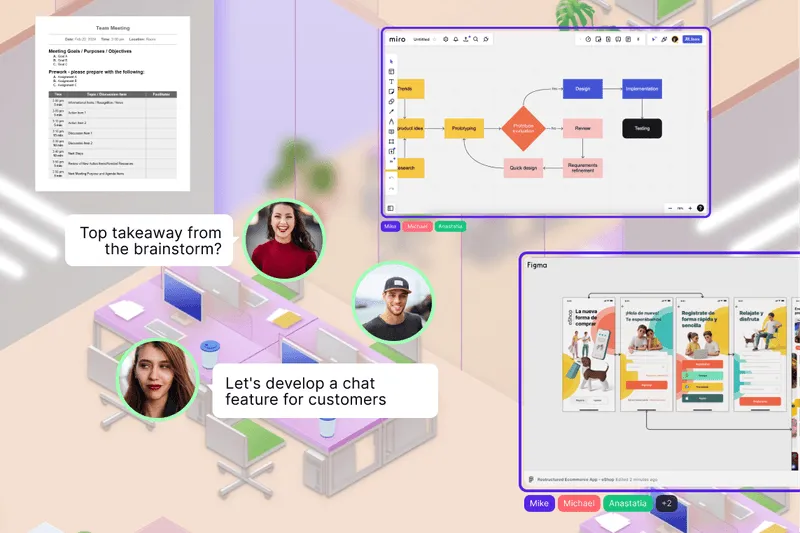
SpatialChat is a virtual office platform which is built around proximity instead of scheduling. Teams move between focus areas and collaboration zones, and spatial audio means conversations fade in as you approach a group and fade out as you leave.
Key features:
Pricing: Free tier available, with paid plans scaling by team size and features, see pricing.
Best for: Teams that want one space for both daily coworking and occasional larger gatherings like town halls, without paying for two separate tools.
Limitation: Less purpose-built for pure AI-driven meeting productivity than platforms designed specifically around that, like SoWork.
Try SpatialChat's virtual office software free to see how proximity-based presence feels in practice.
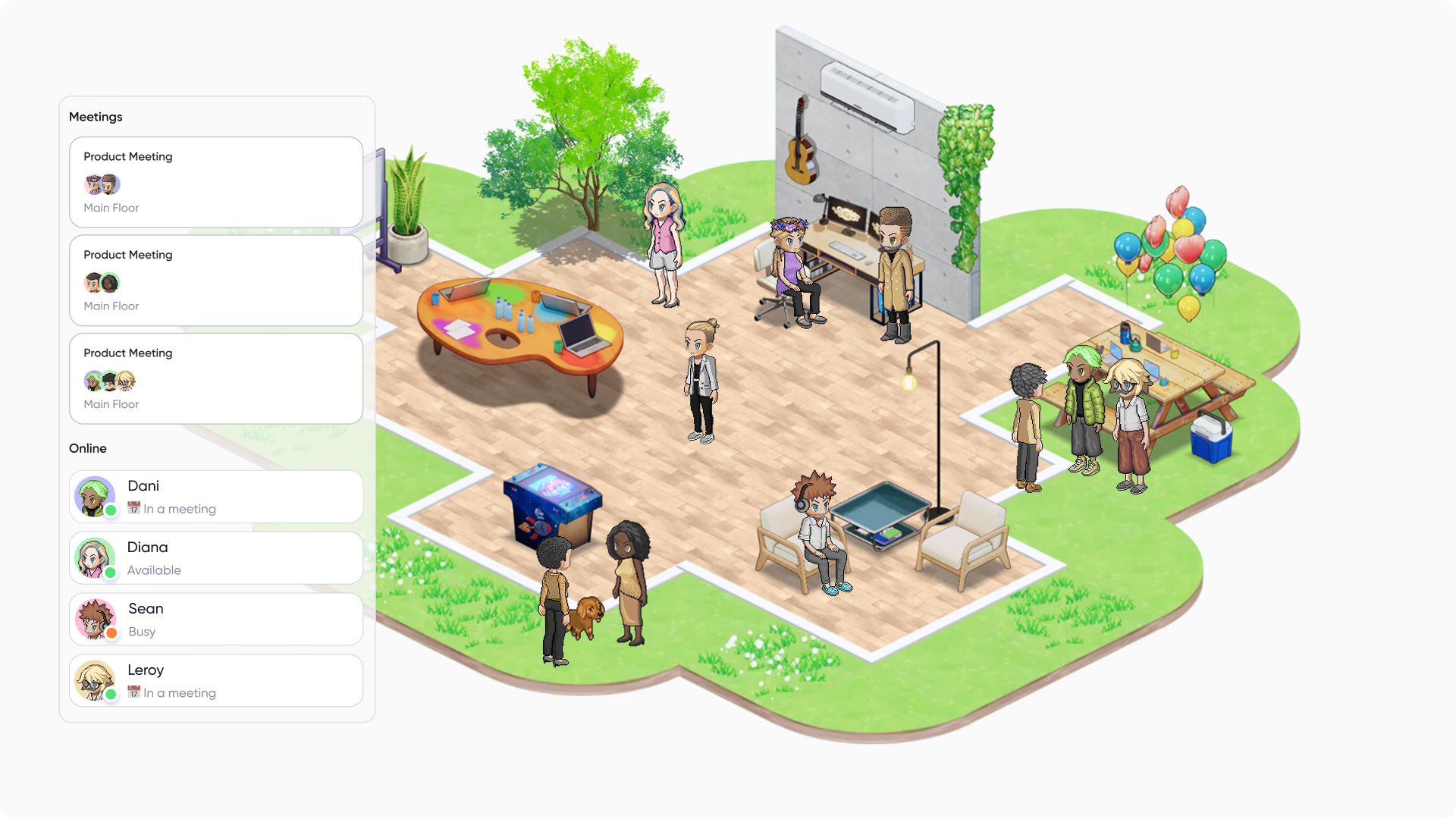
SoWork positions itself as the coordination layer above your existing tools, with AI meeting notes and presence awareness at the center of its pitch.
Key features:
Pricing: Basic tier $6/user/month ($5.40 annually), Premium $15/user/month ($12 annually).
Best for: Teams that want AI handling meeting follow-up automatically, reducing manual note-taking overhead.
Limitation: The immersive world interface adds a learning curve some teams skip via Simplified Mode, which trades away some of the spatial appeal.
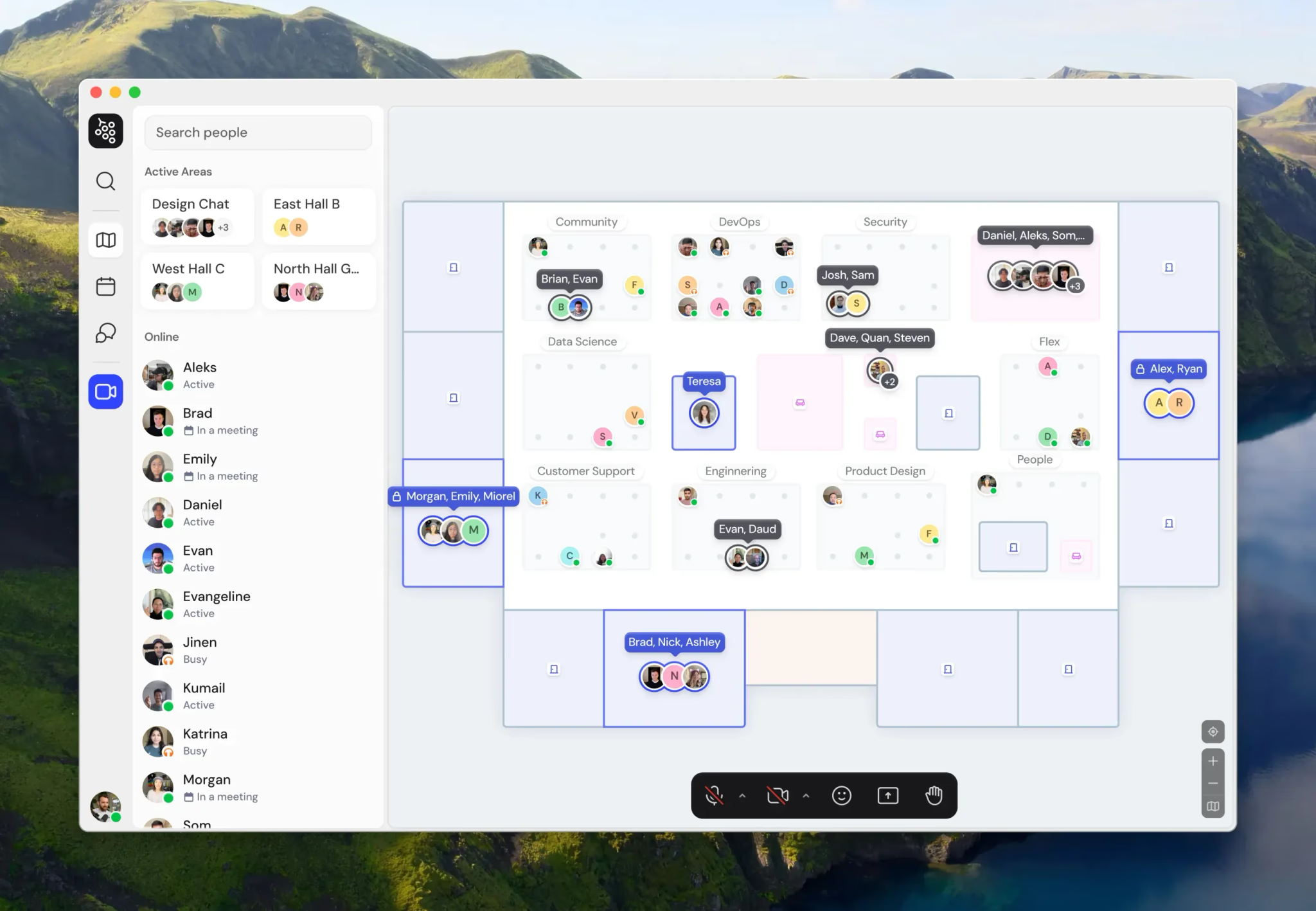
Gather's pixel-art, top-down map leans into a game-like aesthetic, appealing to teams that want culture and fun as much as coordination.
Key features:
Pricing: $12-15/user/month after removing its free tier in late 2025.
Best for: Smaller teams (under 50) prioritizing a playful, creative culture. 12 virtual team building ideas gives a sense of the kind of culture-building this format supports well.
Limitation: Reported to be in maintenance mode with limited new development, and lacks the AI productivity tooling competitors now offer.
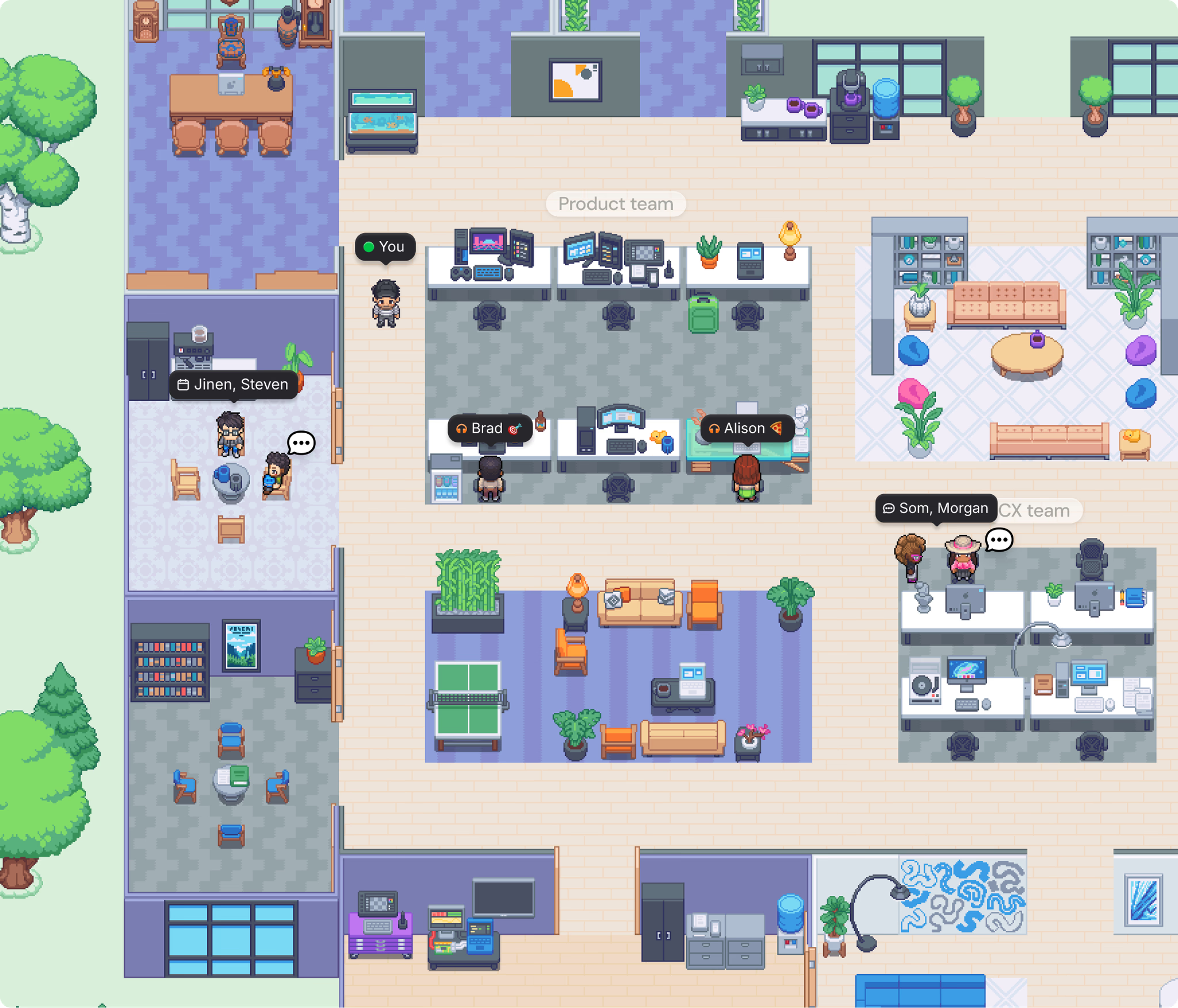
Sococo takes a bird's-eye, architectural approach: a floor plan with rooms, where blinking avatars show activity and a "knock" feature requests entry.
Key features:
Pricing: Standard plan $14.99/seat/month ($13.49 annually), 10-seat minimum. Unlimited plan $24.99/seat, 100-seat minimum.
Best for: Enterprises already running Zoom or Webex who want a visual presence layer without replacing their video stack.
Limitation: Seat minimums make it a poor fit for small teams, and the native media cap on lower tiers can be a real constraint.
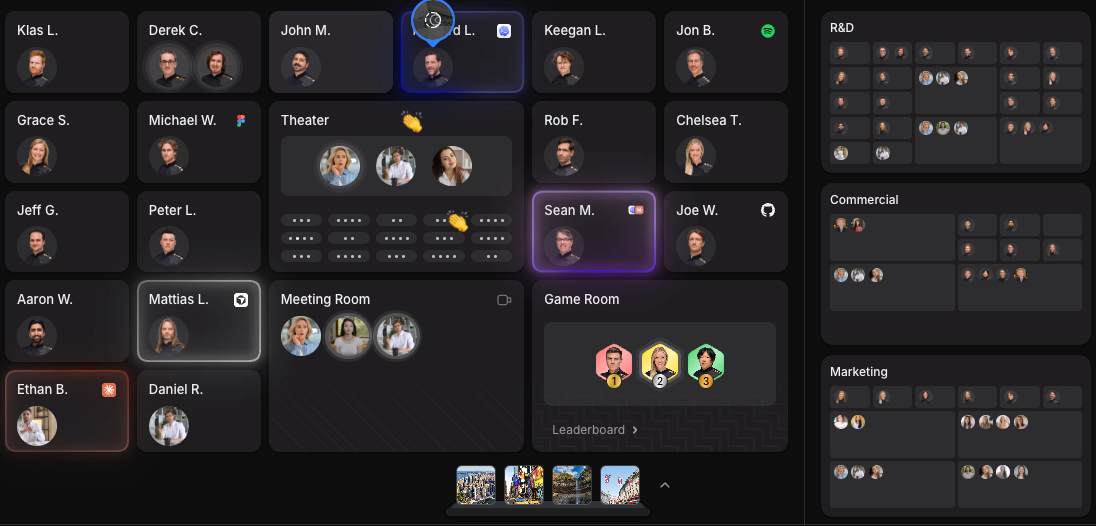
Roam bundles nine products, drop-in video, scheduling, AI notes, screen recording, an AI assistant, chat, all-hands, and events, into a single price with no feature gating.
Key features:
Pricing: $19.50 per active member/month, no annual contracts, billed strictly monthly.
Best for: Remote-first companies of 20-500 who want to consolidate a scattered tool stack into one platform and one bill.
Limitation: No annual discount option, and the flat per-active-member rate can cost more than seat-based competitors for teams with high, consistent daily usage.
Reviewers on G2 report that 85% of members feel more connected to colleagues within two days of adopting Roam, and average meetings run around 8 minutes.
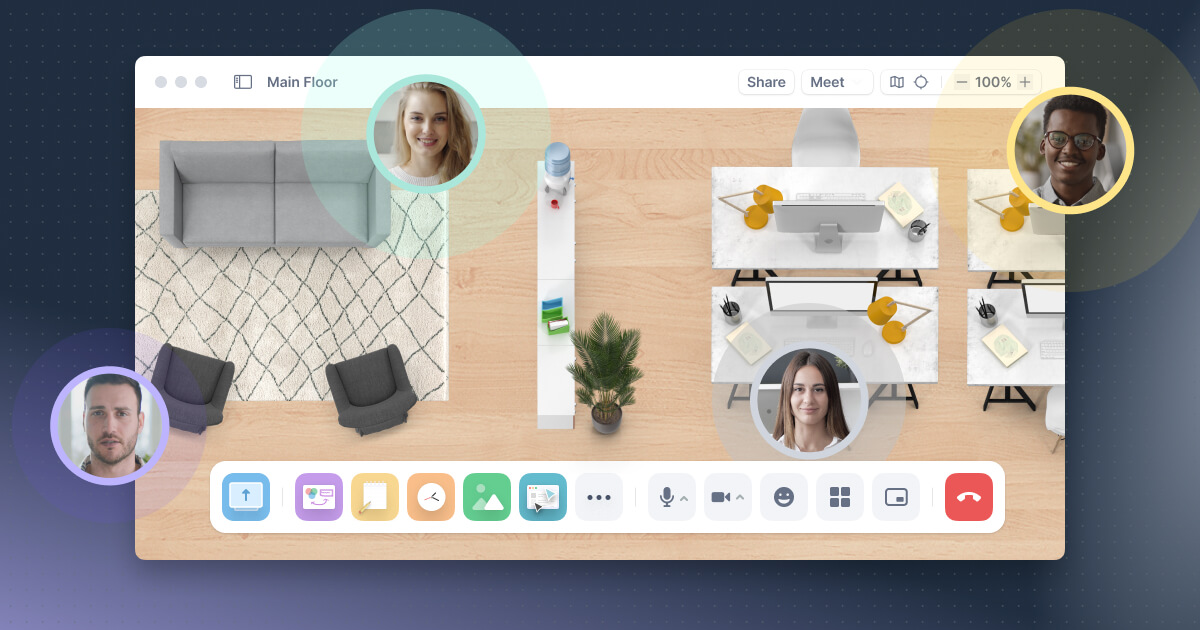
Teamflow's bubble-based interface shows your video moving around a shared space, with audio limited to whoever's nearby, explicitly positioned as work-focused rather than social.
Key features:
Pricing: Free for up to 5 employees. Seed $15/employee/month, Business $25/employee/month (billed yearly).
Best for: Teams that want fewer scheduled meetings and more organic work-alongside-each-other time, without a gamified aesthetic.
Limitation: Less actively marketed than some competitors, and its free tier caps out quickly for growing teams.
Match the platform to your team's actual habits, not the longest feature list:
Trial with a real subset of your team before rolling out company-wide. A platform that wins a sales demo can still fail if people simply don't open it during a normal workday.
There's no single best virtual office platform, only the best fit for how your specific team actually works.
Six real options here span AI coordination, social culture, enterprise presence, all-in-one consolidation, and focused work, and the right one depends on which of those problems you're actually solving.
Start with the platform that matches your team's biggest pain point today, not a hypothetical future need. Try SpatialChat free to see what flexible, proximity-based presence feels like for your team.
SpatialChat, SoWork, and Teamflow all offer free tiers for small teams, typically capped under 10 users. Gather removed its free tier in 2025, and Sococo and Roam have no free option at all.
SoWork is built more specifically around AI meeting notes and summaries as its core differentiator. Roam includes an AI assistant as one of nine bundled tools, but it's not the platform's primary focus the way it is for SoWork.
Some can, others are designed to sit alongside it. SpatialChat, SoWork, Gather, Roam, and Teamflow can replace video calls outright, while Sococo is explicitly built as a presence layer on top of Zoom or Webex rather than a replacement.
Roam and SoWork are both built specifically for remote-first companies without a physical office. SpatialChat and Teamflow work equally well for fully remote or hybrid setups, depending on team culture preferences.
Yes. Roam bills only for members active during the month, and inactive seats don't count. Most other platforms on this list bill per licensed seat regardless of actual daily use.
SpatialChat and Roam both explicitly support hybrid setups, letting in-office and remote employees join the same digital space. Gather and Teamflow work for hybrid teams too, though they're more commonly adopted by fully remote companies.
Two to four weeks is usually enough to see whether a team actually adopts daily habits, rather than just testing features once. Roam and Teamflow both offer trial periods per new member added, which works well for a staged rollout.
Not necessarily, it's a different bet on what drives adoption. Teams that value culture and fun as retention tools often see stronger daily usage on a playful platform than a purely functional one nobody wants to open.
Most platforms offer volume discounts or custom enterprise pricing once you scale past standard tiers. SoWork and Sococo both explicitly discount at higher seat counts, while Roam's flat rate scales linearly with active members.
For small teams, usually not, most platforms are self-serve and browser-based. Larger organizations should still involve IT for SSO setup, security review, and integration with existing calendar and chat tools before a company-wide rollout.